Power Bill Rip-Off: You Pay For Their EVs!

Australians face being forced to subsidise electric-car chargers through their power bills, while the supposed environmental benefits of EVs crumble under scrutiny of coal-powered charging and manufacturing emissions.

Power Bill Rip-Off: You Pay For Their EVs!

The Australian Energy Market Commission (AEMC) now wants electricity consumers to help subsidise otherwise uneconomic “kerbside electric-vehicle charging infrastructure”.

Think about that.

Australian families and businesses have already been smashed by rising electricity costs — and now these fools at the AEMC want to increase electricity bills further to pay for virtue-signalling.

This demonstrates that the head of the Australian Energy Market Commission is completely out of touch, a danger to our economy, and should be sacked.

For the bottom line is this: if electric cars are so great, why do they even need subsidies?

These subsidies only distort price signals and result in an inefficient use of resources, ultimately making Australians poorer. 

Further, these subsidies are a 'Reverse-Robin Hood' - where low income earners and Australians living in regional areas pay more to subsidise wealthy inner city government employees. 

And this latest proposal comes on top of the thousands of dollars in tax concessions and other subsidies already available to electric vehicles.

FREE-RIDERS

Then there is the road-tax free ride that electric cars get.

Every time the owner of a petrol or diesel vehicle fills up, they pay Commonwealth fuel excise — currently 50.8¢/L — plus GST on the excise (a tax upon a tax), for a total of 55.88¢/L attributable to the excise and the GST imposed on it.

However, EV owners don't buy petrol or diesel and therefore pay no fuel excise whatsoever.

And this is despite EVs being substantially heavier than equivalent petrol or diesel cars, thereby potentially imposing greater road wear and tear.

If the pricing mechanism were working effectively, heavier vehicles should be paying more per kilometre to reflect the additional costs they impose — instead, EVs currently pay no equivalent national fuel excise or distance-based road-user charge whatsoever.

And now we're expected to subsidise their chargers as well.

THE GREAT “ZERO-EMISSIONS” MYTH

Then there is the great “zero-emissions” myth.

Electric cars are not zero-emission vehicles. They are zero tailpipe-emission vehicles. There is an enormous difference.

An EV generally starts its life with a substantially larger carbon footprint because of the additional emissions involved in mining and processing battery minerals and manufacturing its enormous battery.

And many of the electric vehicles sold in Australia are manufactured in China, where coal remains a major source of electricity.

Then, after importing all those embedded manufacturing emissions into Australia, we plug the car into the electricity grid and pretend the electricity magically appears from the wall without producing CO₂.

But what happens in the real world is that electric vehicles are commonly plugged in to charge overnight — creating additional electricity demand overnight.

So where does that additional demand come from?

At night, solar generation has gone to sleep. And wind power doesn’t have a control knob that allows you to simply ramp up generation whenever electricity demand increases.

Therefore, if that additional overnight demand in NSW, Queensland and Victoria is supplied by coal-fired generators, electric cars effectively become coal-powered cars.

So let’s do the maths and see whether electric cars charged from additional coal-fired generation in NSW, Queensland and Victoria actually reduce CO₂ emissions.

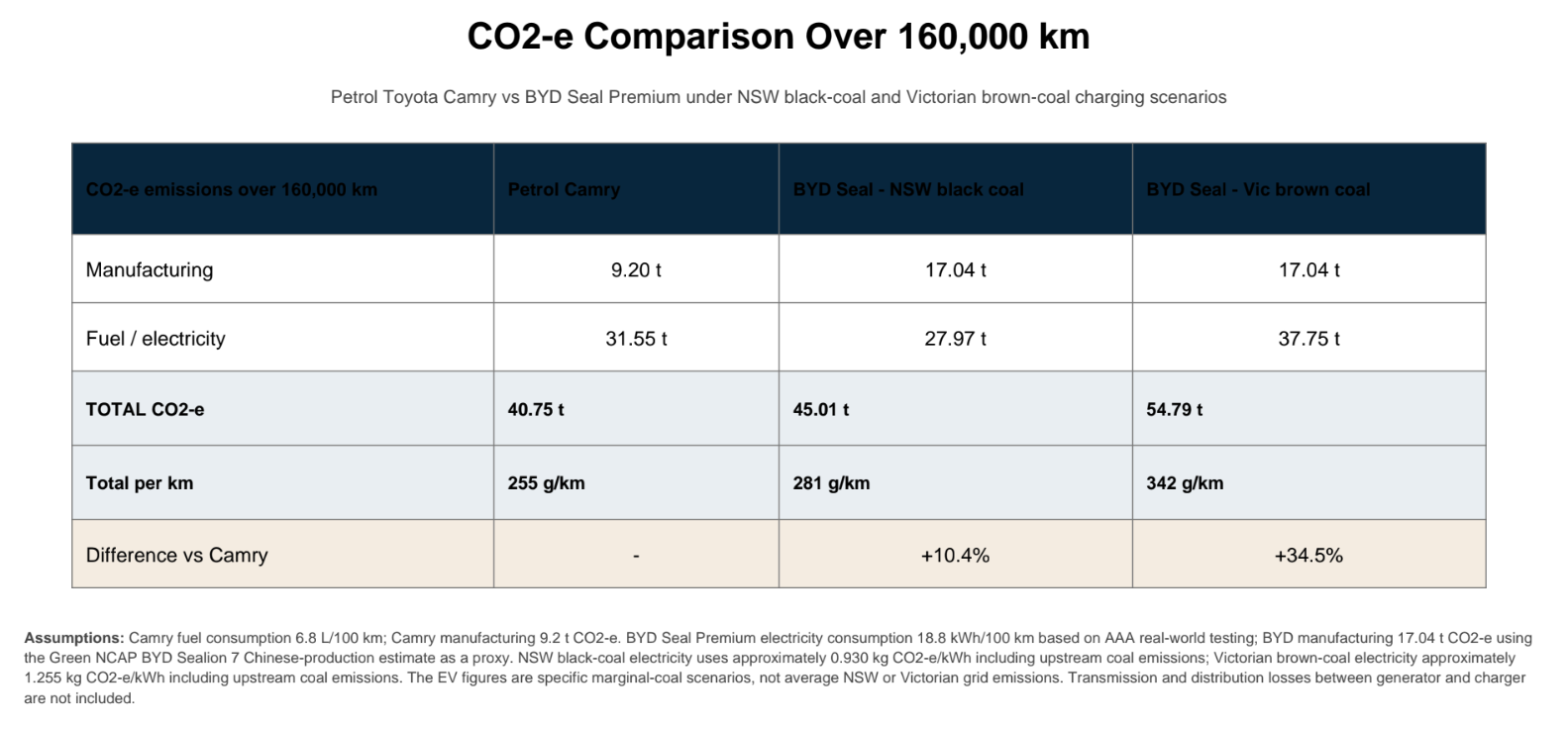
Let's take a real example: the Chinese-manufactured BYD Seal Premium versus a conventional petrol Toyota Camry.

These are the numbers.

In Victoria, under a scenario where the additional overnight electricity required by the EV is supplied by brown-coal generation, the EV produces approximately 34.5% more total CO₂-e over 160,000 kilometres than the conventional petrol car.

In NSW, under a scenario where the additional electricity demand is supplied by black-coal generation, the EV produces approximately 10.4% more total CO₂-e.

The bottom line is this: if you believe electric cars necessarily substantially reduce CO₂ emissions when they are manufactured in China and their additional charging demand is supplied by coal-fired generation in NSW, Victoria or Queensland, the numbers tell a very different story.

If you want to buy an electric car, good luck to you. But it is obscene and immoral to call on struggling Australian families and businesses to subsidise your choice.

HERE ARE THE CALCULATIONS

Manufacturing emissions

Firstly, there are the higher CO₂ emissions involved in manufacturing the electric car.

Using Green NCAP's detailed Chinese manufacturing assessment for the closely related BYD Sealion 7 as a proxy — including an almost identical-sized battery — gives approximately 17 tonnes of CO₂-e from manufacturing.

In comparison, manufacturing a conventional Toyota Camry produces around 9.2 tonnes CO₂-e, based on a 2023 Australian lifecycle analysis using Argonne National Laboratory's GREET 2022 model.

Therefore, the minute you buy your “clean and green” electric car, it starts with approximately 8 tonnes more manufacturing CO₂-e under these estimates.

And there are separate environmental and human-rights questions surrounding the mining and processing of the minerals used throughout global EV battery supply chains.

Manufacturing emissions over 160,000 km

BYD warrants the traction battery for eight years or 160,000 kilometres, whichever comes first. Therefore, using 160,000 km as our comparison distance, here is the maths:

BYD:

17.04 tonnes = 17,040 kg = 17,040,000 grams

Spread over 160,000 km:

17,040,000 g ÷ 160,000 km = 106.5 g CO₂-e/km

So the figure we have is:

BYD manufacturing emissions = ~107 g CO₂-e/km over 160,000 km

In comparison, using the 9.2 tonnes CO₂-e manufacturing estimate for the conventional Toyota Camry:

9.2 tonnes = 9,200 kg = 9,200,000 grams

Spread over 160,000 km:

9,200,000 g ÷ 160,000 km = 57.5 g CO₂-e/km

So the figure to use is:

Camry manufacturing emissions = ~58 g CO₂-e/km over 160,000 km

So the question is: Can the EV offset its higher manufacturing emissions throughout the vehicle's life?

Australian Automobile Association real-world testing in Victoria measured the Seal Premium using 18.8 kWh of electricity per 100 kilometres.

However, it’s worth noting that the AAA's 18.8 kWh/100 km figure was obtained in unusually mild 18–19°C conditions. Therefore, it does not represent the potentially higher electricity consumption required for substantial heating on cold winter mornings or heavy air-conditioning during hot Australian summer conditions — both of which can reduce an EV's efficiency.

However, to be generous to the EV, let’s stay with the 18.8 kWh/100 km figure.

Over 160,000 kilometres, that's:

30,080 kWh of electricity

Now, if the EV is plugged in overnight and we assume the additional Victorian demand is supplied by increased brown-coal generation, using approximately 1.25 kg CO₂-e per kWh, the calculation is:

160,000 km × 18.8 kWh ÷ 100 km
= 30,080 kWh

CO₂ from Victorian brown-coal electricity:

30,080 kWh × 1.25 kg CO₂-e/kWh
= 37,600 kg CO₂-e
= 37.6 tonnes CO₂-e

Electricity emissions per kilometre:

37,600,000 grams ÷ 160,000 km
= 235 g CO₂-e/km

So under the Victorian brown-coal marginal-generation scenario:

BYD electricity emissions = 235 g CO₂-e/km

Now compare that with a conventional petrol car consuming 6.8 litres per 100 kilometres.

Over the same 160,000 km, it burns 10,880 litres of petrol.

Using the Australian Government's National Greenhouse Accounts factors — importantly including both the direct emissions from burning the petrol and upstream emissions from producing and supplying it — gives approximately 2.90 kg CO₂-e per litre.

Petrol consumed over 160,000 km:

160,000 km × 6.8 L ÷ 100 km
= 10,880 litres

Therefore:

10,880 L × 2.90 kg CO₂-e/L
= 31,552 kg CO₂-e
= 31.55 tonnes CO₂-e

Per kilometre:

31,552,000 grams ÷ 160,000 km
= 197.2 g CO₂-e/km

So the figure to use is:

Camry petrol emissions = ~197 g CO₂-e/km

Conclusions

Therefore, plugging an EV into the Victorian grid and assuming the additional overnight charging demand is supplied by brown-coal generation does not offset the EV's higher manufacturing emissions — it adds to them.

The operating comparison alone is:

BYD on Victorian brown-coal generation: 235 g CO₂-e/km

versus

Camry petrol emissions: 197 g CO₂-e/km

Once manufacturing is included, our calculations give approximately:

Petrol Camry: 255 g CO₂-e/km

BYD Seal — NSW black-coal scenario: 281 g CO₂-e/km

BYD Seal — Victorian brown-coal scenario: 342 g CO₂-e/km

Over 160,000 kilometres, that equates to approximately:

Petrol Camry: 40.75 tonnes CO₂-e

BYD Seal — NSW black coal: 45.01 tonnes CO₂-e

BYD Seal — Victorian brown coal: 54.79 tonnes CO₂-e

In NSW and Queensland, the calculation is somewhat better for the EV because black-coal generation has a lower CO₂ intensity than Victoria's brown-coal generation. But under our marginal black-coal scenario, once manufacturing emissions are included, the electric car still produces more total CO₂-e over 160,000 km than the conventional petrol Camry.

The bottom line is this: if you believe electric cars necessarily substantially reduce CO₂ emissions when they are manufactured in China and their additional charging demand is supplied by coal-fired generation in NSW, Victoria or Queensland, the numbers tell a very different story.

Yet government policy continues to subsidise their uptake.

If electric vehicles really are the cheaper, cleaner and superior technology their advocates claim, they should be able to compete without forcing other electricity consumers and taxpayers to subsidise them.

The bottom line is that if you believe electric cars substantially reduce C02 emissions when made in China and driven in NSW, Victoria or Queensland – you’ve been scammed.  

Thank goodness that One Nation has both the brains and moral clarity to call this scam out and has a policy of putting an end to these distorting subsidies. 

Note: If anyone wants to challenge or question the maths behind these calculations - please post your reasons. 

Thought for the Day

“Government is the great fiction, through which everybody endeavours to live at the expense of everybody else.”
– Frédéric Bastiat

Great! You’ve successfully signed up.

Welcome back! You've successfully signed in.

You've successfully subscribed to Confidential Daily.

Success! Check your email for magic link to sign-in.

Success! Your billing info has been updated.

Your billing was not updated.