

Confidential Daily Comment
Fuel Fury: Iran War Sends Aussie Prices Soaring
When the world burns oil, Australia pays.
When the world burns oil, Australia pays.

From Jab Cheerleader to Honest Broker: Karl Stefanovic’s COVID Reckoning
When the major parties stop listening, voters start looking elsewhere.
Australia's climate history has been destroyed and fabricated.


This week marks 117 years since Sunday, 3rd January 1907, when the government-run weather station located at the Post Office in the NSW outback town of Bourke recorded a sweltering 125°F (51.7°C).
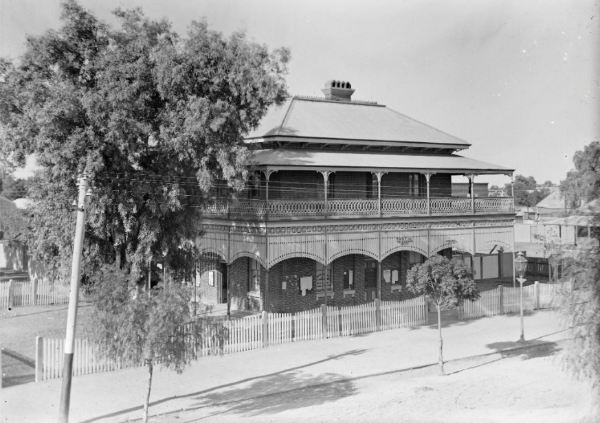
Although higher temperatures were reported in Australia during the great heatwave of 1896, those readings were not taken using a standardised Stevenson Screen. For that reason, Bourke’s 125°F (51.7°C) was long regarded as the hottest reliably recorded temperature in Australia. Bourke’s record extreme heat of January 1909 is well documented in the newspapers of the day, preserved, at least for now, thanks to Trove.
The Western Herald and Darling River Advocate (published in Bourke) reported:
“Since our last issue Old Sol has made himself felt to some tune, putting up a record on Sunday that has not been beaten for 32 years, if it was then. During Christmas week the temperature was comparatively for the time of year, bit New Years gave us 117 in the shade. January 1, 116, January 2, 116, January 3, 125 (51.7°C) and January 4, 116 an average of 118 for the five days.
These figures were recorded by the thermometer which has done duty for some years and which only a week or two ago was tested by an expert from the Department in Sydney and proved to be absolutely correct.
On Sunday last, when 125 degrees in the shade was recorded a fearfully hot wind from the north existed all day and at 9 o'clock that night the glass still showed over 100 degrees.
A dust storm then supervened and lasted throughout Monday, the glass recording 116. A dry thunderstorm occurred on Monday night and then a gals from the south came up cooling the atmosphere considerably. Today has been comparative pleasant.”
The Goulburn Evening Penny Post also reported the extraordinary heatwave, with the temperatures peaking on the Sunday:
"GREAT HEAT WAVE * SIXTH HOTTEST DAY IN SYDNEY *SYDNEY'S RECORD, 104 DEGREES * BOURKE 125.
Only on five other occasions in the history of the Sydney Observatory - now extending over a period of half a century - have higher temperatures been registered in Sydney than that of Sunday. For a brief period during the afternoon the shade reading was 104 degrees - a temperature which has not been approached since the memorable heat wave of December 31, 1901 when the thermometer registered 107.5, only one degree below the highest record...
The conditions now became almost intolerable. The wind from the westward, heated by the bushfires in the interior, was like a blast from a furnace, scorching everything over which it passed. Vegetation perished visibly, and great havoc was played with the poultry yards, one proprietor alone reporting the loss of 1000 head. It was during this blast, at 3.15 p.m., that the maximum temperature was reached.
Then the wind shifted again to the north-east, and the heat slightly diminished.
Intense as the heat was in the city, the conditions in many parts of the, suburbs were still more trying, and some sensational readings were supplied to the Weather Bureau, including the following: - Strathfield 113.2 degrees, Pennant Hills 113, Guildford 112, Croydon 112. Wahroonga 104.5.
Bourke. - The heat on Sunday was terrific. The thermometer registered 125 degrees; At 9 o'clock p.m., it-was still over a hundred. It was hotter than any day during the heat-wave 12 years ago. The lowest shade heat for the past five days was 114 degrees. The barometer is now falling, and a big duststorm is expected. The heat is considerably affecting the old residents.
Brewarrina. - On Sunday the thermometer at the post office registered 123 degrees in the shade."
However, for those who follow the prophecies of Greta and have signed up to the climate cult (along with those profiting from the Net Zero agenda), having Australia’s hottest day occur more than a century ago is an “inconvenient truth” when you are promoting the idea that coal-fired power stations and farting cattle and sheep are causing “unprecedented” heatwaves today.
But, thankfully for the climate scammers, Australia’s Bureau of Meteorology (the BOM) seems to treat Orwell’s 1984 not as a dystopian warning but as a prophetic guidebook—an instruction manual for rewriting history to align with the “climate change” narrative. As Orwell wrote in 1984:
"All history was a palimpsest, scraped clean and reinscribed exactly as often as was necessary…
Every record has been destroyed or falsified, every book rewritten, every picture has been repainted, every statue and street building has been renamed, every date has been altered.
And the process is continuing day by day and minute by minute. Nothing exists except an endless present in which the Party (Climate Alarmist) is always right.”
So the BOM went to work and rewrote history by sending Bourke’s 125°F (51.7°C) straight down the memory hole, brushing it from the record as Australia’s officially recognised hottest ever day in a manner that would make the Ministry of Truth proud.
The BOM has offered three excuses for expunging Bourke’s 125°F (51.7°C) and rewriting the historical record, so I’ll go through each one, not to debunk them, but to show how they demonstrate that the BOM has misled the public and engaged in an act of malfeasance. The record must be restored.
BOM’s EXCUSE #1
The first excuse the BOM fabricated was the claim that no other official weather stations recorded similarly high temperatures on the same day, asserting that “no other station in New South Wales or southern Queensland is known to have exceeded 47.2°C on this day.” This excuse is false.
The closest official government weather station to Bourke in 1909 was at Brewarrina, around 100 km to the east. Newspapers of the day, records of which are readily available on COVID-era, reported a temperature of 123°F (50.6°C) at Brewarrina on 3 January 1909.
Further, before the COVID-era restrictions, I personally inspected and photographed the original handwritten Brewarrina logbook of the Meteorological Observations from 1909 at the Government Archives in Western Sydney. It not only confirms the 123°F reading but also shows the same extreme-heat pattern seen at Bourke, with Friday and Saturday also exceptionally hot and then an unprecedented heat surge on Sunday.
Note that the 123°F is written in the logbook under 4 January 1909. This is because the entries record temperatures for the previous 24 hours, meaning the figure listed for 4 January is actually the maximum for the day before, Sunday 3 January 1909.
Given that the original 1909 Brewarrina handwritten logbook records an almost identical pattern of unprecedented heat, this should be game, set, and match. The BOM has gotten it completely wrong; they should acknowledge the error and reinstate the Bourke record.

But the observations from the official Brewarrina station are not the only evidence confirming the extreme heat on that Sunday in 1909. The Cobargo Chronicle (published Friday, 8 January 1909) reported a temperature of 123°F at Goodooga, about 200 km northeast of Bourke, for the same day.
And further still, the temperatures reported by the Western Herald and Darling River Advocate appear to have been from a different site in Bourke from the official Government weather station located at the Post Office, although they also report 125°F for 3 January 1909, the temperatures they list for 1st, 2nd, and 4th January differ from those recorded at the official government weather station.
BOM’s EXCUSE #2
The second fabricated excuse that the BOM relies upon to rewrite history is a nonsensical “comparison of the temperature at Bourke with the mean of temperatures observed at Thargomindah, Walgett and Coonamble on days when the daily maximum temperature at Bourke exceeds 40°C.” Incredibly, this comparison by the BOM was carried out using data from the period 1959–95.
Given that site and instrument changes can significantly affect measurements, a comparison taken 50 to 90 years after the 1909 observation is, at best, a joke. So, the question is: why would the BOM make such an unusual and flawed comparison using data from 1959 to 1999, 50 to 90 years after the Bourke record of 1909?
Could it have anything to do with what Dr Bill Johnston noted, that at Bourke, “a large 230-litre Stevenson screen installed in 1908 moved at least once in the post office yard and from the 1950s it was shaded and surrounded by watered lawns”? Making a comparison using data from 50 to 90 years later, which just happens to coincide with the period when Bourke’s Stevenson screen was relocated to a site “shaded and surrounded by watered lawns,” not only renders the BOM’s comparison worthless, but it stinks of intentional fraud.
BOM’s EXCUSE #3
The third excuse used by the BOM for rewriting history is the claim that the 125°F (51.7°C) is an “observational error” (perhaps the individual operating the weather station had lost his glasses?)
The BOM argue that the original handwritten Meteorological Observations also recorded 125°F on Saturday, 2 January, the same temperature recorded on Sunday, 3 January.
The BOM argues that Sunday’s reading of 125°F would therefore “be affected by the same error which was corrected in the case of the 2 January observation.”
Again, this is a completely bogus excuse. If you examine the original handwritten logbook, there was no “observational error” on 2 January. The temperature recorded that day was 112°F.
The practice at the time was that the observer who took the measurements entered them in the logbook using black ink. To ensure accuracy, an auditor would later double-check the handwritten entries and make any notes or corrections in red ink.
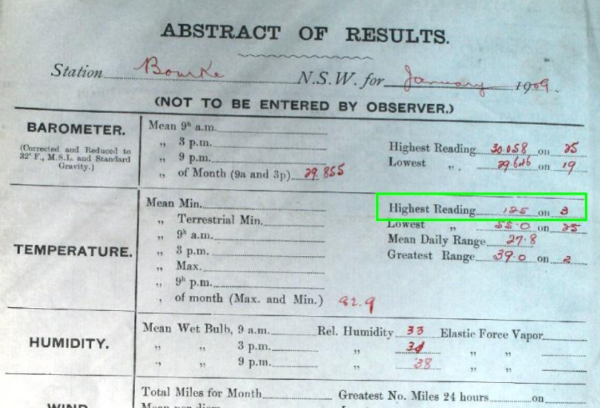
At the end of each month, the auditor would complete a separate monthly summary. (See the attached photograph of the January 1909 summary page from the original logbook held in the National Archives; note that the printed form clearly states that the data on this page is “Not to be entered by the Observer.”)
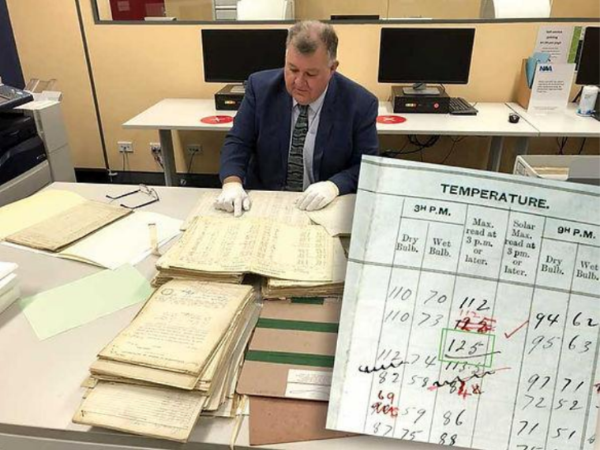
If you look closely at the original log page for the daily Meteorological Observations for January 1909, you can clearly see different handwriting for the entries made in black ink (by the Observer) and those in red ink (by the Auditor).
The original observation for 2 January, written in black ink by the Observer is clearly 112°F. The Auditor, using red ink, first overwrote the 112 to make it 125. They then crossed out this alteration and wrote 112 above it, placing a red tick next to the corrected entry.

The likely reason for this initial confusion by the auditor was that temperatures at Bourke were normally not recorded on Sundays. However, given the unprecedented extreme heat, it is easy to understand why the Observer would have checked the thermometer on Sunday, 3 January.
And on the summary page, (Abstract of Results – as attached below) the auditor (using red ink) has recorded the hottest day for January 1909, being the 3rd day at 125°F.
CONCLUSION
And as Orwell also noted: “If all others accepted the lie which the Party imposed, if all records told the same tale, then the lie passed into history and became truth.”
The BOM’s feeble excuses for rewriting history are a joke, and we cannot allow their skulduggery in fabricating our history to stand.
Having had the privilege of inspecting the original handwritten records from over a century ago (see attached image), I was struck by the sense of pride that leaps from the pages, pride in the hundreds of dedicated professional weathermen and women who, throughout the past century, dutifully recorded daily temperature observations with care and accuracy.
For some snivelling bureaucrat, a century later, to sit in an air-conditioned office and create bogus excuses to rewrite history to fit their ideological beliefs, while falsely implying “observer error,” is an affront to those observers.
And finally, the 125°F (51.7°C) is more than just a number. It is a testament to the hardships and struggles endured by the pioneers who built Australia, something that needs to be taught in every school around the nation.
The 125°F (51.7°C) recorded at Bourke must be restored as Australia’s officially recognised hottest ever temperature, and the BOM held to account for their malfeasance.
Attached are a few images from the Bourke flood of 1890, and images of the township from 1910.
Senator Ian Macdonald: In Australia, we emit, less than 1.3% of the world emissions.
Chief Scientist Finkel: About that.
Senator Ian Macdonald: If we reduce the worlds carbon emissions by 1.3%, what impact would that have on the changing climate of the world.
Chief Scientist Finkel: Virtually nothing.
– Hansard, Senate Estimates, 2017.

When the world burns oil, Australia pays.

From Jab Cheerleader to Honest Broker: Karl Stefanovic’s COVID Reckoning

When the major parties stop listening, voters start looking elsewhere.

When the national broadcaster buries the truth, it isn’t journalism, it’s complicity.
Join 50K+ readers of the no spin Weekly Dose of Common Sense email. It's FREE and published every Wednesday since 2009