The Killer Cyclone History Forgot

As Australia obsesses over modern climate panic, the catastrophic 1899 Cyclone Mahina, and its 400 dead, have slipped quietly from the nation’s memory.

The Killer Cyclone History Forgot

This week marked the anniversary of one of the most devastating events in Australia’s history; an event that should be remembered, honoured and taught in our schools. Yet it passed almost unnoticed, ignored by the mainstream media and largely forgotten by our government.

One hundred and twenty-seven years ago, on the night of March 4, 1899, a monster rose out of the Coral Sea.

Cyclone Mahina, the deadliest tropical cyclone and deadliest natural disaster in Australia’s recorded history, and likely one of the most intense cyclones ever observed anywhere in the world, roared ashore at Bathurst Bay, 167 kilometres north of Cooktown in far north Queensland. At around 11 pm, the storm struck with unimaginable violence. By 10 am the following morning, March 5, Mahina had passed. In its wake, it left a landscape of ruin and an estimated 410 people dead.

At the beginning of March 1899, North Queensland faced a terrifying prospect. Two cyclones were bearing down on the coast: Mahina from the Coral Sea and Cyclone Nachon from the Gulf of Carpentaria. But it was Mahina that unleashed the catastrophe.

The cyclone generated a storm surge of staggering proportions, a wall of seawater estimated to be 15 metres high, racing inland for up to five kilometres. It was a tsunami-like force of nature, the largest storm surge ever recorded from a cyclone, obliterating everything in its path.

What followed bordered on the apocalyptic.

According to a contemporary account, The Pearling Disaster, 1899: A Memorial, Constable John “Jack” Kenny of the Queensland Native Mounted Police was investigating the murder of an Indian crewman from a pearling lugger allegedly attacked by “spear-wielding natives.” Kenny had established camp with four experienced Indigenous trackers near Ninian Bay, about 40 feet (12 metres) above sea level and half a mile inland.

Yet when Mahina struck, seawater surged through the camp to waist depth.

When Kenny later made his way to the coast, he was joined by government official and anthropologist Dr Walter Roth. What the two men encountered defied belief.

The storm had hurled multi-ton boulders across the landscape as though they were pebbles. Where trees still stood, stones were found embedded deep within their trunks. Bodies were discovered hanging in treetops.

Dead sharks and porpoises lay scattered across the land, carried ashore and deposited as high as 20 feet above the sea. Near Ninian Bay, fragments of Aboriginal canoes were found lodged in treetops 70 to 80 feet above water level.

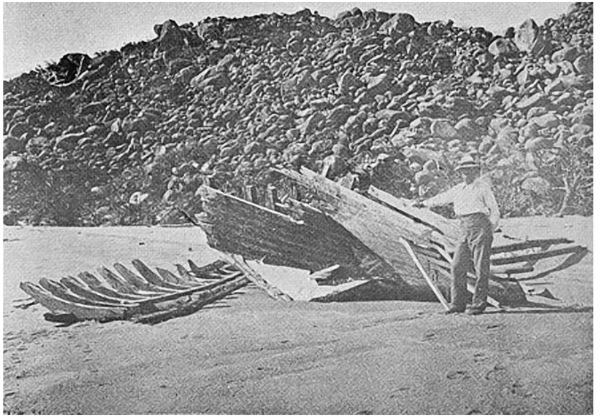
Everywhere they looked, from the rocky shores of the cape to the tops of 40-foot cliffs, there was wreckage. Splintered hulls. Broken masts. The shattered remains of the pearling fleet.

One witness described the scene at Bathurst Bay in haunting terms:

There is quite a forest of mastheads and floating wreckage, the boats having evidently sunk at the anchorage. There are tons of dead fish, fowl and reptiles of all descriptions, and the place presents the appearance of a large cemetery. All the trees have been stripped of their leaves.

Most of Mahina’s victims were divers and seamen working on the Thursday Island pearling fleet.

They were men drawn from across the Torres Strait, the Pacific islands and Southeast Asia, working in what was then one of Australia’s great wealth-creating industries. After commercial quantities of pearl oysters were discovered in the Torres Strait in 1869, the pearling industry exploded. Pearl shell was prized throughout the world for buttons, jewellery, furniture inlay and decorative ornaments.

By the late 1890s, the industry employed around 2,000 workers, operating fleets of two-masted luggers from its headquarters on Thursday Island.

But pearling was brutally dangerous work.

Men drowned regularly. Primitive diving equipment failed. After the introduction of diving suits, the greatest killer became decompression sickness, “the bends.” Sharks circled constantly. The highly venomous Irukandji jellyfish lurked unseen in the water. Disease spread easily in the cramped and unsanitary conditions aboard vessels.

Yet nothing inspired more fear among pearlers than the sudden, merciless fury of a tropical cyclone.

On the morning of Saturday, March 4, 1899, as many as 1,000 men, women and children were aboard around eight schooners in the region, while more than 100 pearling luggers lay anchored nearby to unload shell.

Within twenty-four hours, the fleet had been annihilated.

The remains of the lugger Zanoni washed ashore near boulder-strewn Cape Melville after Cyclone Mahina.

By 10 am on Sunday morning, more than half the vessels were gone, and at least 400 people were dead.

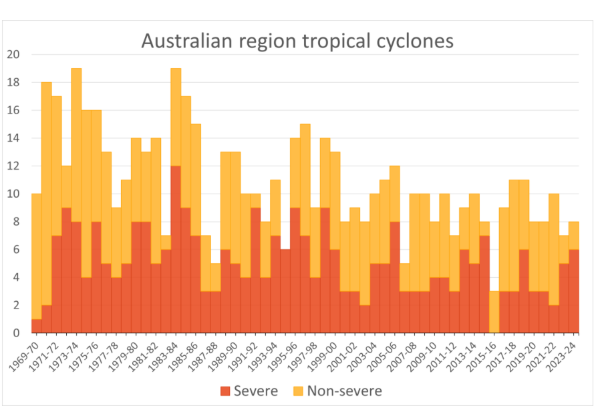
Cyclone Mahina remains one of those inconvenient facts that rarely appears in modern discussions of climate catastrophe. If the climate is becoming ever more extreme, as we are constantly told, then how is it that cyclones striking Australia, both severe and non-severe, appear to be declining? And how is it that the most powerful and deadly cyclone ever to strike the continent occurred in 1899, decades before a single coal-fired power station had been built?

Perhaps it is simply easier not to mention it.

Easier to allow such events to fade quietly from public memory.

But history matters.

The number of severe and non-severe tropical cyclones since 1970/71 which have occurred in the Australian region.

These events are part of the story of Australia, of the people who lived, worked and died on this continent. Remembering them anchors us to reality. It reminds us who we are and where we came from. When history is forgotten or ignored, a nation loses the compass that helps it understand itself.

When history is silenced, critical thinking is often silenced with it.

And perhaps that is why so many today seem content to let these anniversaries pass without so much as a whisper.

Thought for the Day

The most effective way to destroy people is to deny and obliterate their own understanding of their history.
– George Orwell

Great! You’ve successfully signed up.

Welcome back! You've successfully signed in.

You've successfully subscribed to Confidential Daily.

Success! Check your email for magic link to sign-in.

Success! Your billing info has been updated.

Your billing was not updated.