The Great Beer Rescue
The remarkable true story of a shipwreck, a rescued beer keg and the Australian spirit of mateship.
With so much bad economic news around, as the worst government in our nation's history drives the economy off a cliff, sometimes we need something a bit lighter to keep our sanity.
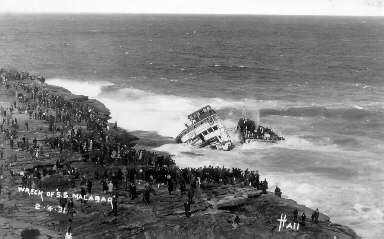
So here's a chapter and sneak preview from my soon-to-be-released book titled Bondi Beach: The Spirit of Australia. The chapter is titled "The Great Beer Rescue" and is about the wreck of the Malabar in 1931.

It is difficult to imagine a more Australian scene. Here was a ship lying broken beneath the cliffs after a dramatic wreck. Yet a handful of volunteers risked life and limb to save a single keg of beer... and then shared it amongst everyone.
Perhaps no story captures that uniquely Australian spirit better than the story of what became known as The Great Beer Rescue following the wreck of the MV Malabar in 1931.
As the great passenger and cargo steamer slowly broke apart beneath the cliffs at Long Bay in Sydney's eastern suburbs, thousands of Sydneysiders flocked to watch the spectacle. Wreckage drifted ashore throughout the Easter weekend—timber, bags of flour, tins of food and other cargo scattered across the rocks and beaches.
Then came the discovery that electrified the crowd. Floating amongst the wreckage were several wooden kegs containing whisky, rum and—most importantly—beer.
Police officers, determined to prevent looting, smashed open every cask they could reach. But one stubborn keg of Victorian beer escaped their attention. It drifted into a narrow cleft amongst the rocks where an enterprising band of young men spotted their opportunity.
Lowering themselves down the slippery cliff face, they reached the prize just before another heavy sea crashed over the rocks. For one terrifying moment, a large wave swept one of the rescuers off his feet and into the foaming surf below. Thousands watching from the clifftops gasped in horror, fearing the worst. Miraculously, he scrambled back to safety, battered but otherwise unharmed.
The beer rescue continued.
Six determined volunteers hauled the precious keg up the steep cliffs, carrying it almost ceremoniously while an ever-growing crowd followed behind as though accompanying some priceless treasure.
Reaching the top, someone produced a block of timber and drove out the bung with a mighty blow. A fountain of beer erupted into the air. There was only one problem. Nobody had brought a glass. Those nearest the keg simply knelt down and drank what had pooled on top, before someone produced a battered two-pint pannikin. It was passed from person to person as complete strangers patiently waited their turn. There was no pushing, no fighting and no scrambling to keep the beer for themselves. The newspaper summed up the scene perfectly:
"There was delightful lack of formality in the disposal of this keg, and an utter absence of selfishness."
It is difficult to imagine a more Australian scene. Here was a ship lying broken beneath the cliffs after a dramatic wreck. Police had done their best to destroy the cargo. A handful of volunteers risked life and limb to save a single keg of beer.
Then, rather than keeping it for themselves, they shared it with anyone who happened to be standing nearby. No tickets. No VIP area. No one asking who deserved the first drink, all drinking from the same old pannikin. Just ordinary Australians enjoying an unexpected stroke of good fortune together.
Many nations have stories of shipwrecks. But only Australia could produce a tale in which one of the most enduring memories of a maritime disaster was the successful rescue of a keg of beer—and the fact that it was shared freely with complete strangers.
It is humorous, almost absurd, yet beneath the laughter lies something deeper. It speaks of the egalitarian spirit that has long defined Australia: mateship over status, generosity over greed, and the instinct to share rather than hoard.
The story of The Great Beer Rescue has endured for almost a century. It is about far more than beer. It is about the kind of people Australians have always aspired to be. And on a windswept clifftop above the Pacific, as strangers passed around a battered pannikin filled from a salvaged keg, the Spirit of Australia was on full display.
Here's the passage from the Sydney Morning Herald Saturday, 4th April 1931:
The shores became almost obliterated beneath the wreckage and cargo that were washed in. Timber predominated—but there were bags of flour, tins of food—butter, biscuits, spaghetti, beans—and many carcases of meat done up in calico for export. Most of this was seized eagerly. It was soon found that many of the bags of flour were quite good inside, while there were thousands of tins of edible material that were not broached.
WORTHY OF RESCUE.
Indeed, they were worth saving, for they were real treasure-trove—kegs of whisky, beer, and rum. Unfortunately, orders had come from somewhere that they were not to be taken away, and police got busy and smashed open all that came within their reach. One large keg of Victorian beer, however, escaped. It became lodged in a cleft in the rocks, and its position was carefully noted. In the afternoon about a dozen men and youths essayed its rescue.
They clambered down the face of the cliff, and were about to heave it upwards when a terrible wave broke, drenching them. They ran for shelter, but a following wave, bigger than the first, crashed on the rocks, and a boy was carried off his feet and sucked beneath a swirl of foam and wreckage.
For an instant it seemed that he must be dashed against the rocks, and a cry of horror went up from the crowd, but he emerged unscathed, though dazed. He soon rejoined his mates in the rescue operations.
The keg was lifted up the face of rock, and then someone produced a large, stout bag. On this the keg was laid, almost reverently. It took six men to lift the precious burden, which by slow stages was carried up the headland.
A large crowd followed it. Near the top a halt was called. Someone produced a large piece of wood. The cork was struck a hefty blow, and a cascade of beer rose in the air and fell on the crowd.
Then it was discovered that no one had anything out of which to drink the precious fluid. Those nearest got down on their knees and lapped what remained on the top of the keg. Then a man appeared with a two pint pannikin (a metal pan) The bearers of the burden received first drinks, but everyone around who desired it was given a draught from the pannikin.
However, it was discovered that this method of dealing it out was wasteful, as much was spilt. Someone brought along two iron rods from a shed where excavation work has been in progress. The keg was lifted on to these and taken to the shed. There was a rush to get in with it, but the carriers succeeded in locking the door behind them.
A form in blue appeared on the horizon, "Police!" called out someone, and there was a rush away from the shed. The policeman entered. He remained in it a couple of minutes—then discreetly walked away and out of sight. The crowd, like bees round a honey pot, gathered again. Billies appeared magically, were passed through a window, and came out full and frothing.
"Welly goo' beer," remarked a Chinese appreciatively as he ran off, with a companion, to the shelter of a rock, where the contents of a large can were sampled further.
There was delightful lack of formality in the disposal of this keg, and an utter absence of selfishness.
If you enjoyed this chapter, I hope you'll support the book when it's released later this year.
“Good company, good wine, good welcome, can make good people.”
– William Shakespeare
Join 50K+ readers of the no spin Weekly Dose of Common Sense email. It's FREE and published every Wednesday since 2009