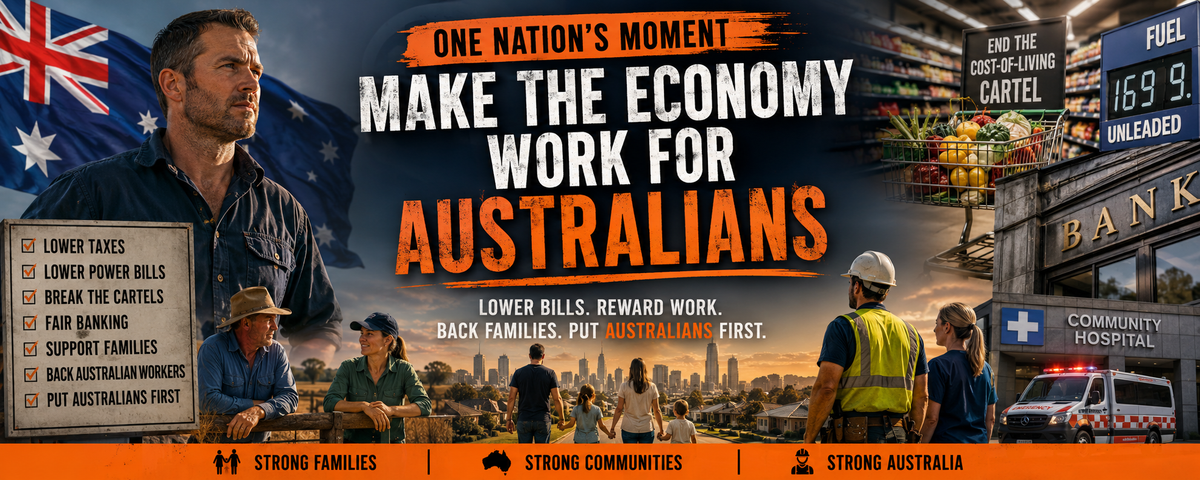
One Nation’s Chance to Put Australians First

Back families. Back workers. Back communities. Put Australians first.

One Nation’s Chance to Put Australians First

For decades, Australians were told the economy was growing, the experts were in charge, and the country was moving in the right direction.

Plenty of families would now beg to differ.

They see wages swallowed by tax, mortgages and rent. They see country hospitals downgraded while governments find money for pet projects. They see local businesses undercut, Australian workers overlooked, and taxpayer dollars handed to activist groups that seem to spend half their time lecturing the very people who fund them.

This is why One Nation’s surge in the polls matters. It is not just a protest against Anthony Albanese, Labor or the Coalition’s collapse into mush. It is a sign that millions of Australians no longer believe the old parties are capable of making the economy work for the people who actually live here. The first part of any serious economic reset has to deal with the weekly pain: tax, power bills, groceries, banks and childcare. That's what we outlined in yesterday's edition of Confidential Daily.

One Nation’s Moment to Make the Economy Work for Australians
One Nation has a chance to move from being the place people park a protest vote to being the party that puts a serious economic plan on the table.

But there is another half to the job. It is about family fairness, Australian jobs, country hospitals, taxpayer-funded activism and foreign aid. In other words, it is about whether the government still understands its first duty is to Australians. That should not be a radical idea. In Canberra, it probably is.

Start with the family tax system, because this is one of those quiet injustices that never gets much attention in the press gallery. A single-income family can pay far more tax than another household earning the same amount, simply because the income is earned by one parent instead of two. Same total income. Same number of mouths to feed. Different tax bill. Why? Because one parent decided to spend more time raising the children.

That might look untidy on a Treasury chart, but it is how many families actually live. Some parents want one of them home while the children are young. Some families do it because shift work makes childcare impossible. Some do it because a child has extra needs. Some do it because the cost of childcare would swallow half the second income anyway. And some do it because they think raising their own children matters. Radical stuff, apparently.

A Family Wage Tax Cut would let couples with dependent children split income for tax purposes, capped at household incomes of $180,000. That is not a handout. It is fairness. Families earning the same total income should not be punished because one parent carries more of the paid work while the other carries more of the care work. The tax system should not act like a scolding auntie, tut-tutting at the kitchen table because a family has made the wrong approved life choice.

The usual crowd will hate it, of course. They will call it backwards. They always do when someone suggests parents should be free to arrange their own lives without permission from Canberra. Let them. Most Australians know the value of a parent at home, even if bureaucrats seem determined never to price it properly.

Then there is government procurement, which sounds dull enough to put you to sleep, but is actually one of the most important levers the government has. Procurement just means how the government spends public money. And public money should build Australia. It should not be used to hollow out local industry, reward import dependence, sideline Australian workers or hand contracts to firms that treat local labour as an inconvenience.

Every government dollar should back Australian workers wherever practical. If Australian firms can provide the goods or services properly, they should be first in line. If local producers can supply the materials, use them. If Australian workers can do the job, hire them. Businesses substantially reliant on imported labour should not be at the front of the queue for taxpayer-funded contracts while local workers watch from the sidelines and wonder what sort of country does this to itself.

This is not complicated. A country that cannot make things becomes weak. A country that cannot build, repair, manufacture, grow, process and supply what it needs becomes dependent on people who do not necessarily care whether we sink or swim. We had a taste of that during the pandemic. Suddenly, the same people who spent years sneering at local manufacturing discovered that supply chains are not fairy dust.

You cannot run a serious country on slogans, consultants and shipping containers. Australia needs skills, trades, workshops, factories, farms, mills and truck depots. The plain, unfashionable stuff that keeps the place alive. Government spending should help rebuild it. Not every contract can go local. Sometimes the capability is not there. Fine. But the default should be Australia first, not “cheapest overseas option first” followed by a glossy report about resilience.

The next policy is even more basic: no more closing country hospitals. There are few things more insulting than watching governments find billions for pet projects while regional communities lose essential health services. Emergency departments downgraded. Maternity wards shut. Mental health support stretched so thin it is barely there. Families told to drive hours for care, as if distance is just a line on a bureaucrat’s map.

Anyone who has lived outside the capital cities knows what that means. A child gets sick in the middle of the night. A birth goes wrong. A farmer has an accident. A young bloke in town hits a mental health crisis, and there is nowhere close to go. A crash happens on a dark regional road, and minutes matter. These are not policy abstractions. They are real moments in real towns, and a hospital nearby can be the difference between a scare and a funeral.

A Community Hospital Guarantee would require emergency, maternity and mental health services in regional communities above defined population thresholds. If states downgrade those services, they should lose federal funding. That will annoy the health bureaucracies. Good. There is no point sending federal money into state systems that keep stripping services from the very communities that need them most.

Regional Australians pay taxes too. They grow the food, dig the resources, move the freight and keep huge parts of this country functioning. They should not have to beg for services that city voters simply expect. Australia cannot keep talking about the regions while quietly removing the things that allow families to stay there.

Then we come to the racket that has become almost normal in modern government: taxpayer-funded activism. Public money should fund services, not campaigns, lawfare, ideological training or political pressure groups using government grants to lobby for more government power, more regulation and more money for themselves. This has gone on for years. Governments hand money to organisations supposedly delivering services, and then some of those organisations somehow find the time and resources to campaign, litigate, lobby and lecture the public.

Taxpayers end up funding the bureaucracy, and the activists who demand the bureaucracy grow even larger. Neat little business model, isn’t it? A One Nation reform agenda should end taxpayer-funded political campaigning. If an organisation receives Commonwealth money, that money should not be used to influence elections, campaign for legislative change or run partisan advocacy.

Public grants should not fund activist litigation either. Australians should not be forced to pay for lawfare designed to stop projects, bully opponents or win through the courts what activists cannot win at the ballot box. The DEI industry should also be cut loose from the public teat. No Commonwealth money for ideological compliance programs, political re-education contracts or consultancy rubbish dressed up as workplace enlightenment. If private companies or charities want to spend their own money on that nonsense, they can go right ahead. Taxpayers should not be forced to pay for it.

Transparency should be non-negotiable. Any organisation receiving public money should disclose how much it gets, what it is for, what executives are paid, how much is spent on advocacy, what foreign funding it receives and what campaign activity it conducts. Misuse the money, and it should be clawed back. Keep doing it, and the funding should end.

That is not an attack on charity. Real charities doing real work should have nothing to fear. It is an attack on the activist class that has learned to live off taxpayers while sneering at them.

Finally, foreign aid. This is where the professional compassion industry starts hyperventilating. The moment anyone suggests cutting foreign aid, we get the usual sermon. Australia has obligations. Australia must show leadership. Australia’s reputation is at stake. Apparently, the nation’s moral standing depends on sending billions overseas while Australians queue at food banks and country towns lose basic services.

What about our obligation to Australians? What about the pensioner choosing between heating and medication? What about the young couple who cannot afford rent, let alone children? What about the town losing its bank branch, its hospital services and its young people? What about the small business owner trying to keep staff employed while every level of government finds new ways to make life harder?

Australia’s first duty is to its own citizens. That sentence should not be controversial. Yet somehow, in polite political circles, it almost is. Foreign aid should be abolished as a standing budget entitlement and redirected to domestic priorities. Emergency humanitarian help can still be considered case by case, where there is a clear Australian interest and proper accountability. But the automatic assumption that billions should leave the country every year while Australians struggle at home has had its day.

Charity begins at home because responsibility begins at home. The defenders of the current system will ask how these policies can be paid for. They always ask that when the money might go to Australians instead of their preferred causes. The better question is how we can keep paying for the mess we already have.

A tax system that punishes single-income families. Procurement rules that fail Australian workers. Regional health services cut to the bone. Activists funded to campaign against the people paying their bills. Foreign aid treated as untouchable while Australians are told to lower their expectations. The money is there. It is just being spent according to the wrong priorities.

A serious One Nation agenda should be built on a very simple order of duty. Australians first. Families first. Workers first. Farmers first. Small businesses first. Local communities first. After that, if there is money left and a clear national interest, we can discuss everyone else.

That is not cruel. It is responsible. The old parties will hate it because it exposes them. Labor has become a vehicle for unions, activists, bureaucrats and inner-city moral theatre. The Liberals talk about enterprise, but too often end up serving donors, consultants and corporate Australia. The Nationals talk about the bush, then somehow keep watching services disappear from the towns they claim to represent.

No wonder voters are looking elsewhere. One Nation does not need to become another party of timid slogans and frightened press releases. It needs to speak plainly and put policy behind the frustration already running through the country: family tax fairness, Australian workers first, country hospitals protected, taxpayer-funded activism ended, and foreign aid brought back home.

That is a serious second half of the agenda. It will not fix everything overnight, and only a fool would pretend otherwise. But it would at least show that someone has noticed the country is heading in the wrong direction. A country is not an economy with a flag stuck on top. It is a home. Governments should remember who lives in it.

Thought for the Day

The family is the test of freedom, because the family is the only thing that the free man makes for himself and by himself.
Gilbert K. Chesterton

Great! You’ve successfully signed up.

Welcome back! You've successfully signed in.

You've successfully subscribed to Confidential Daily.

Success! Check your email for magic link to sign-in.

Success! Your billing info has been updated.

Your billing was not updated.